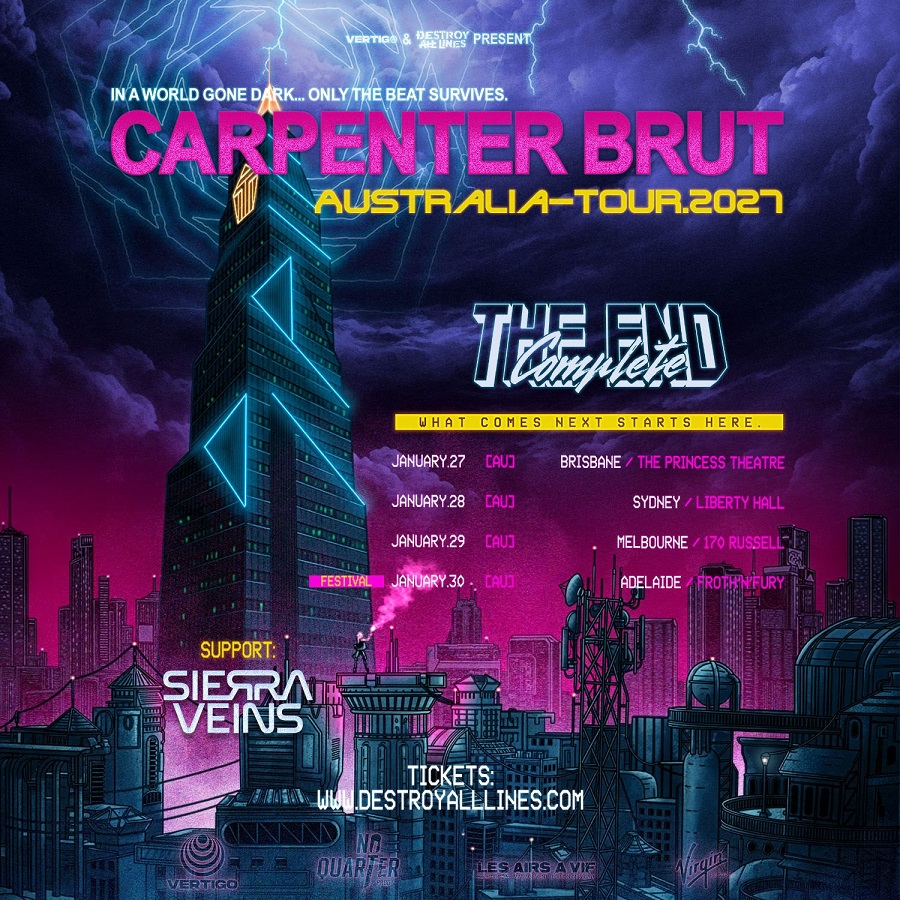
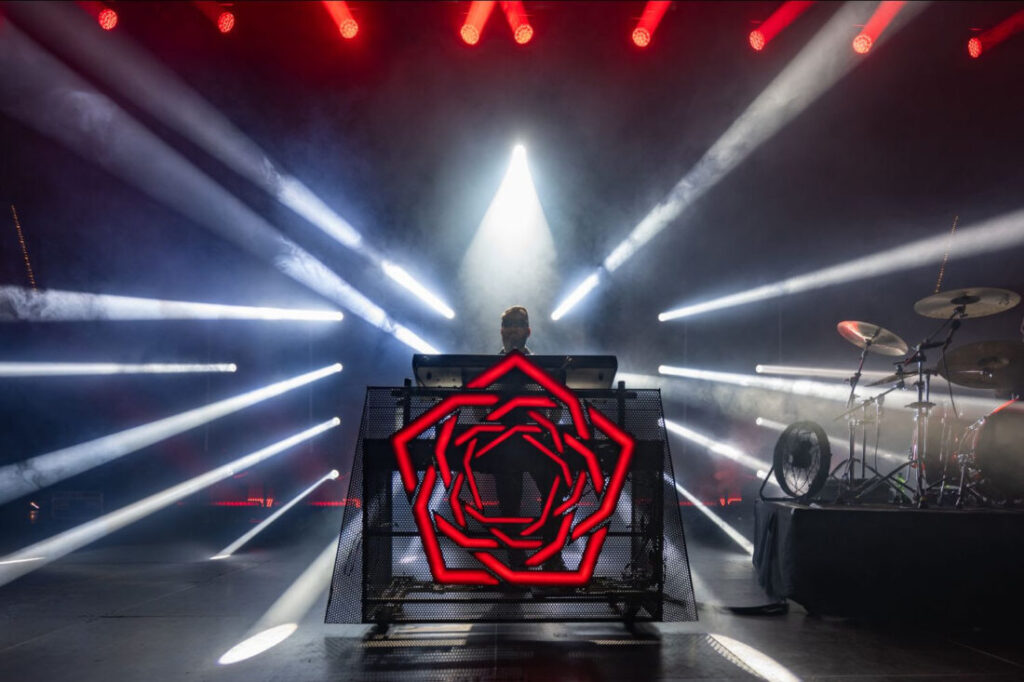
French synthwave powerhouse Carpenter Brut will finally unleash his acclaimed full live production on Australian audiences this January, announcing three exclusive east coast headline shows in the lead up to whats expected to be a landmark appearance at Froth & Fury Festival in Adelaide.
For more than a decade now, Carpenter Brut has blurred the lines between electronic music, metal and cult horror cinema, creating a sound that is as much indebted to
John Carpenter, Slayer, Justice
His jaw dropping live performances have become the stuff of legend at Europe’s biggest festivals, while his music has found another devoted following through film, video games and a strong of releases that have helped define modern synthwave.
The Australian tour follows the release of Leather Temple, the final piece of a trilogy that began with Leather Teeth (2018) and Leather Terror (2022). Part concept album, part imagined film soundtrack and part dystopian fever dream, Leather Temple has firmly established Carpenter Brut as one of the genre’s most ambitious and distinctive artists.
Joining Carpenter Brut on all Australian dates will be fellow French electronic producer
Sierra Veins, whose dark, atmospheric sound is the perfect introduction to a memerising night of synths, beats and cinematic intensity.
Ahead of his Australian debut, we caught up with Carpenter Brut to talk about bringing his full live production down under, the final chapter of the Leather trilogy, his cinematic influences, and what the future holds for one of synthwave’s most distinctive artists.
You’re finally bringing Carpenter Brut to Australia. What are you most excited about when it comes to the trip and connecting with your Australian fans?
It’s my first time in Australia, so mostly I just want to discover it. Playing in front of a crowd that seems to have crazy energy, first of all, but also seeing what life is like over there. There’s also the Mad Max side: the wide open spaces, the roads stretching as far as the eye can see, that’s bound to speak to me. My only worry is liking it too much and not wanting to go back to France, haha.
You’re also performing at Froth & Fury in Adelaide alongside Knocked Loose, Igorrr, Deicide and a huge lineup of international and Australian artists. What are you most looking forward to about being part of the festival?
Being surrounded by such extreme bands, it’s a change from my everyday life, and that’s what I love about metal festivals: everybody is there for the music, without too many genre barriers. Deicide is a legend, and bumping into Igorrr on the other side of the world, a fellow Frenchman, is going to be funny. And as always at these festivals, I hope to share a few beers backstage with friends from the metal scene.
The Leather trilogy has created such a strong visual and cinematic world. Have you ever considered expanding the story beyond the albums and turning it into a full-length film or series?
I’ve thought about it, of course, and I’d love to see it on screen. But let’s be realistic: who would pay to make a film out of this story, and what studio would drop 50 million on it? Today, that kind of slightly crazy project doesn’t really exist anymore. Composing a soundtrack for a real film, on the other hand, is something that could interest me one day, but right now I really don’t have the time.
You’ve spoken about being heavily influenced by filmmakers such as John Carpenter and Dario Argento. Have you ever had the opportunity to meet any of your cinematic heroes?
No, I’ve never had the chance, and I’m not sure I’d want to in the end. You probably know the saying, “never meet your heroes.”
You’ve described Leather Temple as the final chapter of the Leather trilogy. At what point did you know the story was ready to come to an end?
From the very beginning of the trilogy, haha. More seriously, I didn’t really know what to tell after Leather Terror. And while I was composing that one, I had the idea of cryogenically freezing Bret Halford to launch him into the future in the next episode. I’ve always been a fan of Blade Runner-style worlds, or Iron Maiden’s Somewhere in Time. It was a chance to finish the story in a universe I love.
The story has evolved quite dramatically from Leather Teeth to Leather Terror and now Leather Temple. Did Bret Halford’s character evolve alongside the music and the story?
Yes, completely. He went from disfigured geek to rockstar, to killer, then frozen, and finally cyborg. To me, he represents my musical evolution pretty well: with each album, I had to reinvent myself. Deep down, since he’s a serial killer, I don’t really see myself sharing much with him, haha, but on the surface, he grew up with the music. We evolved together, all the way to his final redemption where he sacrifices himself for a noble cause.
With Leather Temple, there are no guest vocalists or lyrics. Was that a conscious decision to allow the music itself to tell the story completely?
Mostly aesthetic, and practical too. I think in film scenes before I think in tracks, and instrumental music lets me compose as if I were writing a soundtrack. And technically, managing featuring artists remotely is pretty complicated. Since I wanted to keep this album as direct and frontal as possible, I preferred to avoid wasting time and energy on that. Everyone can also make their own movie while listening to it.
You’ve worked with some incredible vocalists throughout the trilogy, including Greg Puciato, Mat McNerney and Kristoffer Rygg. What did each of those voices bring to the Carpenter Brut universe?
Each voice brought a very different color. Greg Puciato is raw intensity, rage and precision at the same time. Mat McNerney brings a more theatrical side, almost like a storyteller, which fits the narrative aspect of the universe well. And Kristoffer Rygg has a dark, almost haunted presence, which gives it a more gothic feel. And above all, they’re great guys I loved working with, and I enjoy running into them at festivals when the occasion comes up.
You’ve always created music that feels like the soundtrack to a movie that doesn’t exist. When you’re writing, do you actually visualise specific scenes or sequences?
Yes, always. I ask myself the same question while composing: what am I scoring here, a car chase, the villain’s entrance? Once I have the scene in my head, the music follows naturally: the tempo, the silences, the build-ups. I also use musical references that work like the clichés of action or fantasy films that we all have somewhere in our heads. It’s a musical vocabulary rather than a written one, but the effect stays the same.
After three albums and the completion of the Leather trilogy, where do you see Carpenter Brut going from here?
I feel like heading toward something more experimental, but still electronic, with a more gothic aesthetic, early 20th century: old, slightly unsettling photographs, haunted houses, that kind of imagery. Probably shorter formats, EPs rather than albums, or maybe even just standalone tracks, I compose and it comes out, without dealing with endless promo. I’ll also do features again with singers I like. I’m going to take my time now.
TOUR DATES
Wed, Jan 27: The Princess Theatre, Brisbane 18+
Thurs, Jan 28: Liberty Hall, Sydney 18+
Fri, Jan 29: 170 Russell, Melbourne 18+
Sat, Jan 30: Froth & Fury Fest, Adelaide AA
TICKETS
daltours.cc/CarpenterBrut