Review: Christian Stanger
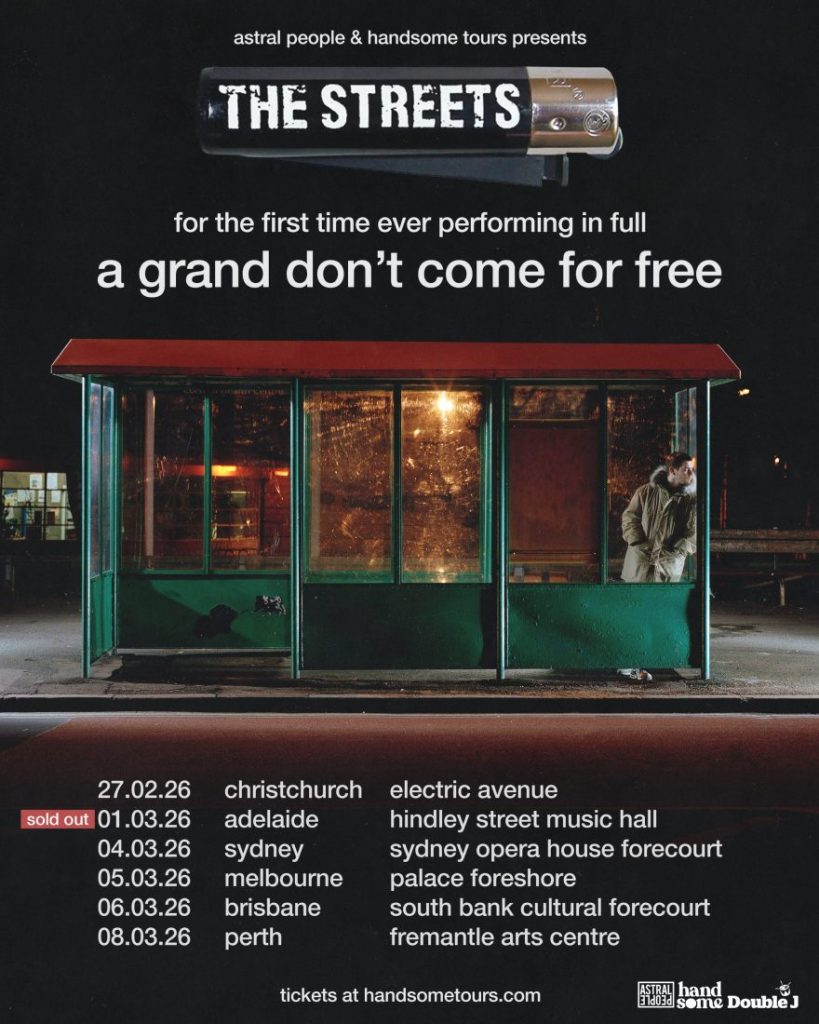
On a Friday night, with humidity climbing toward triple figures, Brisbane finds itself hosting a poetry recital. Not the kind you might expect inside the Playhouse or Concert Hall, but something closer to a civic sermon delivered outdoors at the South Bank Cultural Forecourt. If London has Speaker’s Corner, with its eccentrics, preachers and amateur philosophers flogging pamphlets, Brisbane briefly has its own version. The only difference is the preacher is Mike Skinner, here to deliver the full narrative arc of The Streets’ album A Grand Don’t Come For Free — a moment in time from the early 2000s, and a story of loss, love and redemption.
Something has to be said about the venue. The South Bank Cultural Forecourt did seem like a pretty odd place to stage a series of shows like this, being almost too close to everything else. It sits in the shadow of QPAC and the Lyric Theatre, hemmed in by the river as it snakes past, with the Wheel of Brisbane towering over the stage. But the uneven ground that threatens the unwary (or inebriated), and the gnarled roots of massive trees pushing up through the grass, lend it a kind of looseness that suits it. It’s not built for purpose, but it’s had a few of those. It works as a smaller, scruffier Riverstage, and it’s exactly what Brisbane needs.
Skinner brings Sydney trio Shady Nasty as national support, and it’s easy to see why. The band have been making noise over the past few years, building a cult following with their hybrid of spoken-word rap, post-punk guitars and sweeping synths. There’s definitely something very “Streetsy” in the lyrical delivery and subject matter, but it’s backed by clanging guitars, walls of reverb and atmosphere built for open-air spaces.
Unfamiliar with the trio until just this week, each song seems almost too short, as if it’s building to something that never quite breaks. But the unresolved tension feels intentional. The mood these three create is a snapshot of right now: anxiety through the roof, slightly disconnected, but delivered with a surprising amount of musical muscle behind the poetry.
Like Skinner, the writing is localised and observational, filled with small details and overheard snippets of everyday conversations. It’s these moments that elevate the performance, making it feel somehow universal. Stage lights dim, and the first sampled horns push out across the Forecourt. The crowd around me snaps to attention. Everyone is on their marks, trying to get ahead of the first line.
“It was supposed to be so easy…”
The words arrive in fragments from all directions. Half the line at the wrong timing, attempted South London cadences echoing through the crowd, sentences aborted mid-delivery behind me — and The Streets haven’t even started yet. Skinner isn’t even on stage.
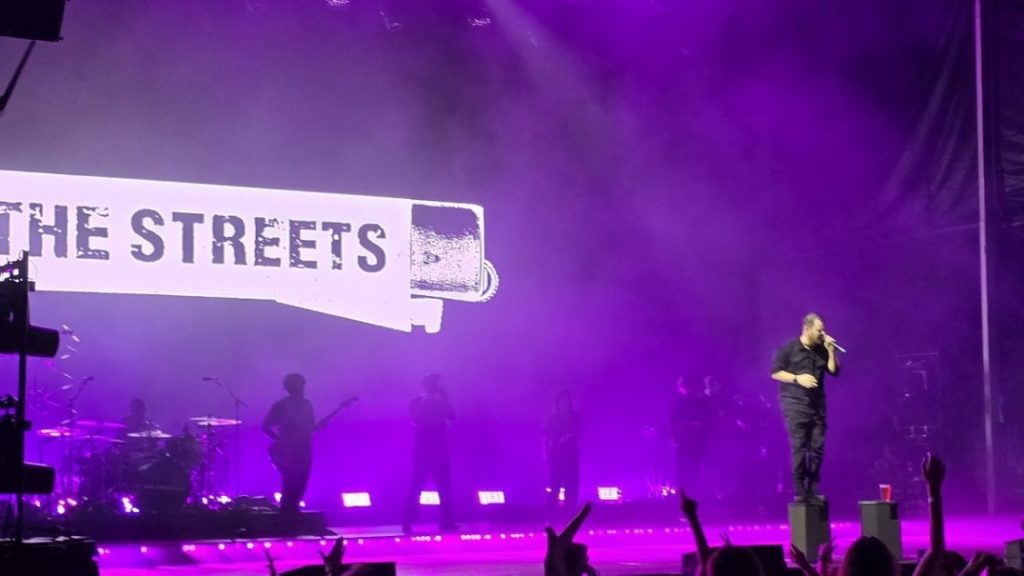
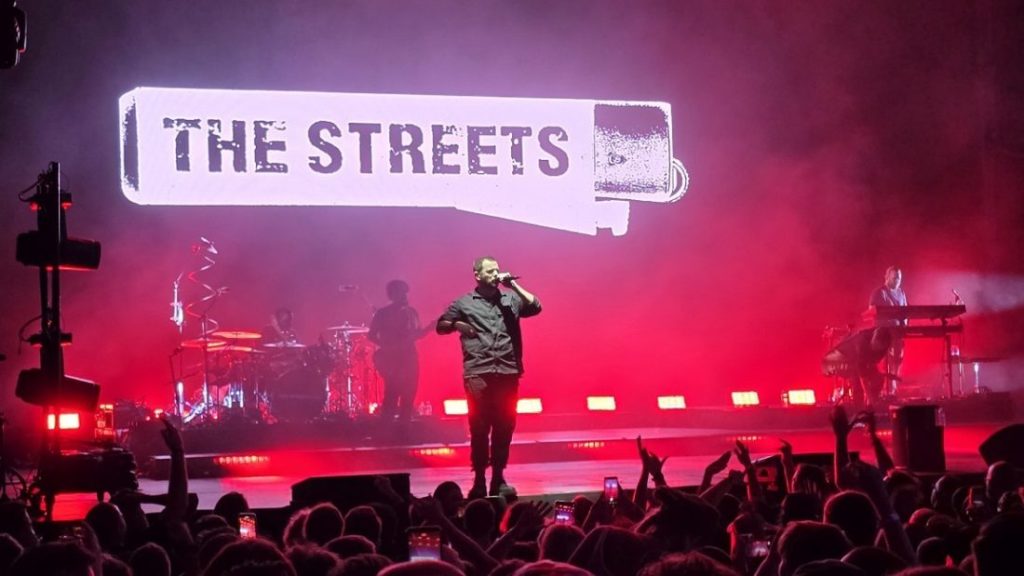
Finally, the man himself walks out in a leather jacket (insane for the weather, quickly discarded), stepping into the light as that first track locks in with the snare. He doesn’t so much rap as narrate, that familiar half-spoken cadence unspooling the story of a manic day, a missing wad of cash, a “broken tele” and creeping paranoia that things are unravelling.
Around me the singing drops to murmurs and hushed conversations, as if in a Shakespearean theatre. People know the record, but this one isn’t for shouting. This one’s a story.
From there the show settles into its roles. Skinner takes centre stage, pacing but confined, letting the narrative spill out as the musicians around him bring the scene to life. Behind them, the projection of the famous bus shelter shifts between day and night, marking the passage of time.
Vocalist Roo Savill appears as the girlfriend, trading lines and arguments with Skinner as they meet in “Could Well Be In” and the relationship frays in “Get Out Of My House”. Kevin Mark Trail, cast as Skinner’s mate (or is he?), steps in when the vocals need to soar. Each track unfolds like a short scene.
Skinner’s deadpan delivery and small gestures do the work. One minute he’s perched on a speaker, head in his hands and spiralling through “Blinded By The Lights”. The next he’s playing up to the crowd in “Fit But You Know It”, before paranoia returns and he’s side-eyeing the betrayal bubbling up in “What Is He Thinking?”
After the climax of “Empty Cans”, the thousand quid is rescued from behind the TV and the story finally resolves. That’s the cue for the theatre to end and the party to begin.
Skinner and company disappear briefly before returning to the ominous string stabs of “Turn The Page”, the original cigarette lighter logo glowing behind them. The mood immediately lifts. The crowd singing takes on monstrous dimensions of cockney-cadence incompetence, but nobody seems too concerned with accuracy.
Skinner loosens up as well. The banter flows freely, repeatedly referring to Brisbane as “Brisneyland” while running through a line of classics including “Let’s Push Things Forward”. Somewhere in the middle, a plan emerges — a crowd-surfing shoey. Logistics are sorted for the rendezvous after sourcing a suspiciously “box-fresh” Converse from a willing (and now wet-shoed) punter.
“Has It Come To This” and “Weak Become Heroes” hit like nostalgia grenades. Beers fly and spliffs are lit.
Finally, as “Too Much Brandy” winds down, the odyssey begins. Skinner is already horizontal above the crowd, drifting across the Forecourt as “Take Me As I Am” kicks in. At the pre-arranged moment, the filled shoe appears and the contents are dispatched mid-surf without a hitch. This is a man fully committed to the Australian leg of his holiday.
Years ago, while living in Australia, Skinner was reportedly told by local industry insiders that his beats would “do nothing here” and was encouraged to return to London to make a name for himself.
Nights like this suggest he might have earned some vindication in the meantime.
Two decades on, thousands of Australians are shouting every word back at him in thick humidity on the banks of the Brisbane River.
Not a bad ending for what I thought would be a poetry recital.